









November 16, 2026 · 8 min read · Repairs
Water still standing on a flat roof two days after rain is ponding. Learn what causes it, why it wears out the roof and how it gets fixed.
The short answer
A flat roof should drain. Water that is still sitting there two days after rain is ponding.
Ponding means a drain is blocked, a low spot has formed or the roof was built with too little slope. Standing water wears out seams faster and finds every weak spot in the membrane. Clearing a drain sometimes fixes it. When the roof itself holds water, the fix is building in slope, which is often done during a repair or replacement.
Puddle or ponding?
Every flat roof holds a little water right after a storm. That is normal. A common rule of thumb in the roofing trade is this: if water is still standing about 48 hours after the rain stops, in sun and heat, the roof has ponding.
Our afternoon storms make this easy to miss. A puddle can dry by morning, then refill the next afternoon. Over a rainy season, the same spot may stay wet for weeks. Look the morning after a dry day. Water that is still there is the warning.
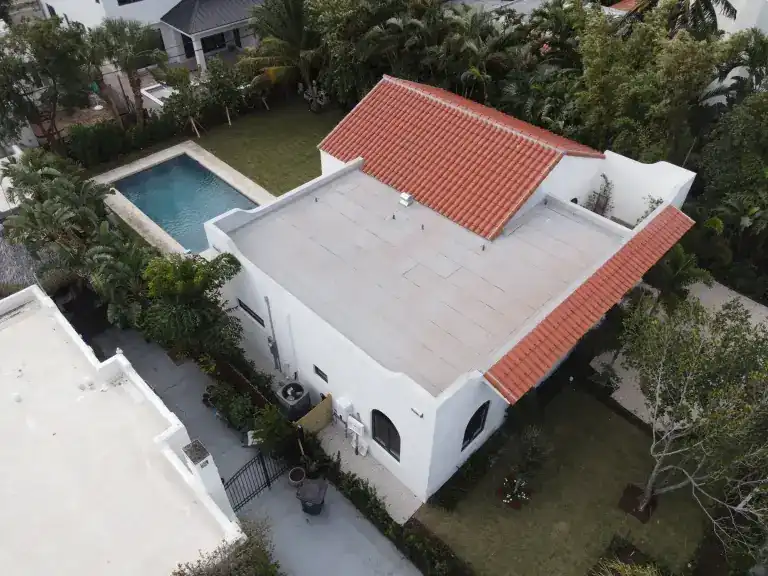
Here, flat roofs are not just on commercial buildings. They sit over porches, garages, Florida rooms and additions. Many older homes in the county have a flat roof over the main house. The same rule applies to all of them.
Why standing water matters
A flat roof membrane is built to shed water, not to hold it. Water that sits causes trouble in a few ways:
- Seams take the strain. Most flat roof leaks start at a seam or flashing. Standing water keeps pressure on those joints.
- The membrane ages faster. Sun on a wet surface, again and again, wears it out sooner around the puddle.
- Debris and growth collect. Leaves, dirt and algae settle in the low spot and hold even more water.
- Weight adds up. Water is heavy. A deep, wide pond adds load to a deck that may already be sagging.
The leak usually shows up last. By the time a ceiling stain appears, water may have been working at a seam for months. Read why some roofs only leak in heavy rain for how water travels before you see it.
What causes ponding
The cause decides the fix, so it is worth knowing the usual suspects:
A blocked drain, scupper or gutter
The simplest cause. Leaves, roof granules or a nest block the outlet. A scupper is the opening at the roof edge that lets water out through the wall. If the pond sits right at the drain or scupper, start here.
A low spot in the deck
The wood or concrete under the roof can sag over time, especially where a leak has already softened it. Water collects in the dip and never reaches the drain.
Wet, crushed insulation
Some flat roofs have insulation under the membrane. When it gets wet, it can compress and form a shallow bowl. That traps more water and makes the problem grow.
Too little slope from the start
Some flat roofs were built nearly dead level. Others had slope that was lost when layers, patches or equipment were added. A roof with almost no slope depends on perfect drains. That rarely holds up for long.
Things in the way
An air-conditioning stand, a curb or a thick patch can act like a small dam. Water backs up behind it.
What you can check safely
You do not need to walk a wet flat roof to gather useful clues. Stay off it after rain. It can be slippery, and a soft deck can give way.
- Photograph the water from a window that looks onto the roof. Note the date and how long since it rained.
- Watch the outlets during a storm. From the ground, check that water is coming out of each scupper, downspout or drain line.
- Look inside below the roof. Check the ceiling under the wet area for stains or soft spots.
- Check the gutters you can see. An overflowing gutter can push water back onto a low roof.
- Write down any recent work. New equipment, a patch or a contractor visit can explain a new pond.
How ponding gets fixed
The fix should match the cause. A roofer should confirm the cause before quoting the fix.
- Clear and repair the outlets. If a blocked drain or scupper is the cause, clearing it and fixing the flashing around it may be enough.
- Add or enlarge an outlet. A low area far from any drain may need its own drain or a larger scupper.
- Build in slope. Tapered insulation is the usual fix for a roof that is too flat. It is insulation cut at a slight angle, so the new membrane sits on a built-in slope toward the drains. Small wedge-shaped sections called crickets steer water around equipment and toward outlets.
- Repair the deck. If the wood or concrete below has sagged or rotted, that section is repaired before the new roof goes on.
- Replace the roof. When ponding has wet the insulation or worn out the membrane across the roof, a replacement with corrected drainage solves both problems at once.
Molsbee Roofing repairs flat roofs and replaces them with modified bitumen or TPO, two common membrane systems here. Our written scope says how drainage will be corrected, so you know what you are paying for. See our flat roof page for the systems we install.
This job is replacing a flat roof – worst roof design in creation – always flooded and leaking. Other roofers said the roof could not be pitched to avoid the incessant pooling. One roofer finally told me that, while he couldn't, Molsbee could pitch the roof. And they did!
Repair or replace?
One pond at a blocked drain, on a membrane in good shape, is usually a repair. The answer changes when:
- Water stands in several places, not one
- The membrane is blistered, cracked or open at the seams
- The insulation below is wet
- There is a leak inside, or several old patches near the pond
- The roof is within or past the typical 15 to 20 year range here
Large repairs also bring in the one-quarter rule in the Florida Building Code. If repairs cover more than a quarter of a roof section within a year, the code generally requires the whole section to meet current code. Our guide to repair or replacement explains how to weigh it.
Flat roof help near you
Read about flat roof repair and replacement in West Palm Beach, Boca Raton, Delray Beach, Boynton Beach, Jupiter, Palm Beach Gardens and Lake Worth Beach. Business owners can read our flat roof maintenance guide.
Next step
Water sitting on your flat roof? Let's find out why.
Schedule a free inspection. We will photograph the problem and give you a written price before work starts.