


January 7, 2025 · 9 min read · Materials
Five roof systems built for hurricane country
Palm Beach County sits in the wind-borne debris region, with design wind speeds from 150 mph inland to 170 mph on the barrier islands. Hurricane season runs June through November. Every roof here has to be built for that, and the material is only half of it. The other half is the underlayment, the fastening schedule and the edge and flashing details that decide whether wind and water get a way in.
Molsbee Roofing has roofed Palm Beach County homes and buildings since 1975. These are the five systems we install for hurricane conditions, and what each needs to perform.
Standing seam metal
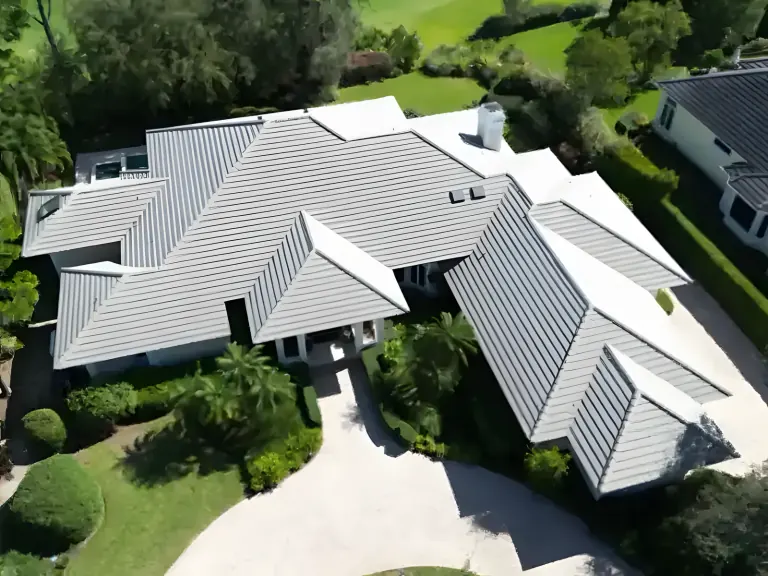
Continuous panels run from ridge to eave, locked together at raised seams and held down by concealed clips. With no exposed screws in the field, there is little for wind to work loose, and the panels act as one surface. Near salt water, the metal, coating and fasteners are specified for corrosion, and incompatible metals are kept apart at every joint. On the barrier islands, where the 170 mph band applies, clip spacing tightens at edges and corners. See metal roofing for the systems we install.
Concrete and clay tile
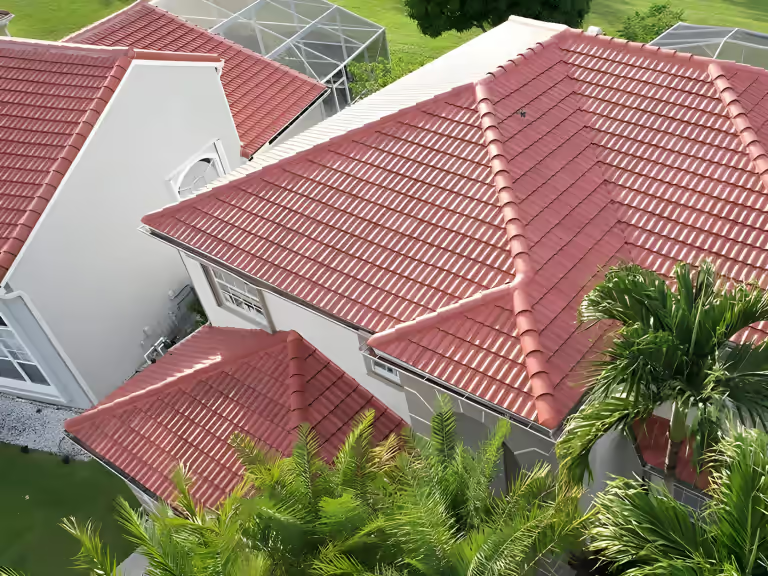
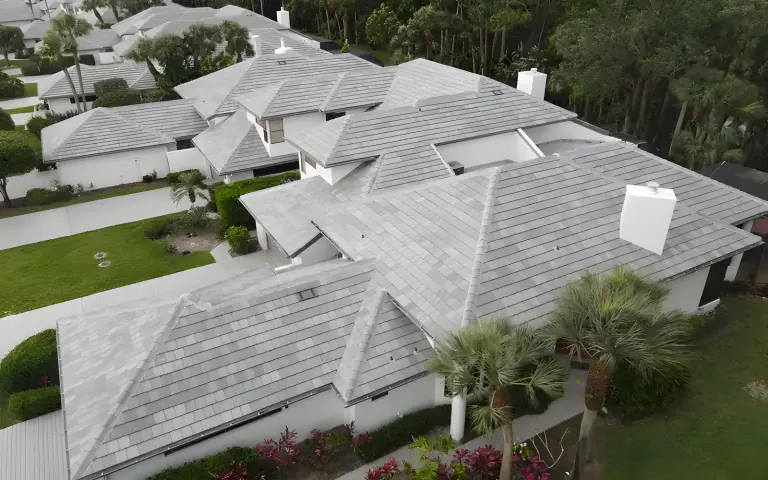
Tile has protected Florida homes for generations. Today's tile is set with approved adhesive or mechanical fasteners, piece by piece, to the Florida Building Code, 8th Edition. Its weight helps it stay put, and a cracked tile can be replaced on its own after a storm. The key point: the underlayment beneath the tile is the waterproofing. If a few tiles are damaged in a hurricane, a sound underlayment keeps water out of the house. On older clay barrel roofs we can detach and reset: lift the tile, replace the underlayment and reset the same tile.
Metal shingle and metal tile profiles
These give a shingle or tile look with the strength of metal. They are much lighter than concrete tile, interlock panel to panel and do not crack. In some historic districts they are also the original material; in Lake Worth Beach, a metal-shingle roof in a district has to be replaced with something that replicates the look of the original.
Architectural and impact-rated shingles
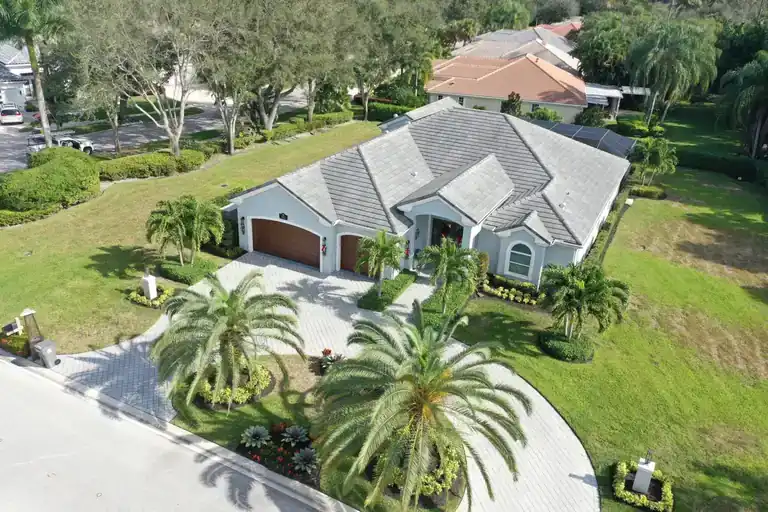
Modern architectural shingles, nailed to the manufacturer's high-wind pattern, are a sound hurricane roof for many homes. Impact-rated lines add resistance to debris. With shingles, installation is everything: the right nailing pattern, starter strips at every edge, sealed ridges and a secondary water barrier beneath.
Flat and low-slope membranes
For flat roofs, porches and commercial buildings, fully adhered or properly fastened TPO and modified bitumen systems resist uplift when the perimeter is right. Most flat roof failures in wind start at the edge, so edge metal and termination details get as much attention as the field. Molsbee Roofing is Carlisle-certified for TPO. More on TPO roofing.
What makes any roof hurricane-ready?
A secondary water barrier. We specify a self-adhered secondary water barrier over the deck, and the Florida Building Code sets secondary water barrier requirements on re-roofs and allows more than one compliant method. If the covering is damaged in a storm, this layer is what stands between the rain and your ceilings.
Fastening to the wind band. The fastening schedule is set by the design wind speed and tightens at eaves, rakes, corners and ridges, where uplift is strongest. It is inspected.
Edges, walls and penetrations. Wind-driven rain finds roof-to-wall joints, edge metal and penetrations first. Those details are named in our scope, not left to the day of the job.
The structure under it. Wind does not stop at the roof covering. In Wellington, an EF3 tornado spawned by Hurricane Milton caused significant damage on 9 October 2024, which is why truss connections and attachment get checked, not just the surface.
What does an inspection tell you before a storm?
A free roof inspection shows lifted shingles, cracked or slipped tile, loose trim, failed flashing and signs of leaks in the attic. It cannot confirm the condition of the underlayment and deck everywhere under an intact covering. We photograph what we find, and if a storm does hit, those photos give you a before-and-after record of your roof.
How do we scope a hurricane roof?
- A free roof inspection of the roof, the flashing, the edges and the attic.
- Photos of the findings.
- A written scope with the price before any work starts, naming the material, underlayment, secondary water barrier, fastening for your wind band and every edge and flashing detail.
Why Molsbee
Since 1975, Molsbee Roofing has built roofs for this county's weather. We hold Florida license CCC1327429, are a GAF Certified Contractor and an Owens Corning Preferred Contractor, and are Carlisle-certified for TPO. Every roof carries our lifetime workmanship warranty and the manufacturers' product warranties, and we can provide a roof certification letter for your insurer after the work.
Get ready before the season
Call (561) 318-8624 or request a free roof inspection. We will show you where your roof stands, in photos, and what it would take to make it stronger, in writing.