





November 28, 2024 · 8 min read · Commercial
Choosing a commercial roof starts with the building, not the brochure
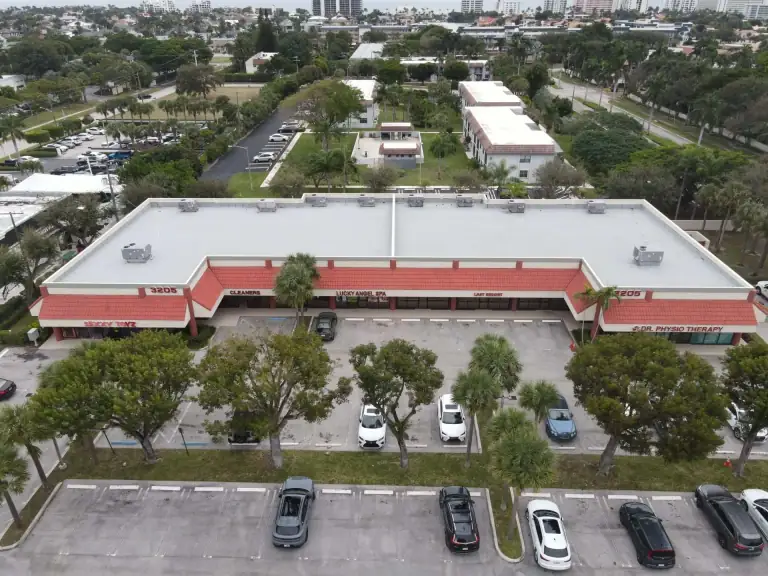
A commercial roof has to work around a business. It covers more area than a house, carries equipment, gets walked on by service technicians and has to be replaced without shutting the doors. In Palm Beach County that roof also has to meet a design wind speed set by the parcel, from 160 mph on most of the mainland to 170 mph along the lagoon, the Intracoastal and the barrier islands. The right system depends on the building. Here are the six questions we work through with owners and property managers before recommending one, and the technical answers behind each.
Molsbee Roofing has worked on commercial and residential roofs in Palm Beach County since 1975.
Factor 1: What can the structure carry, and what is the deck?
The deck decides which systems are on the table and how they are attached:
- Steel deck. Common on warehouses and newer retail. Lightweight single-ply membranes such as TPO suit it well, with insulation boards fastened through to the deck.
- Concrete deck. Common on older offices and condo buildings. Membranes are usually fully adhered, since fastening into concrete means drilling every anchor.
- Wood deck. Found on smaller commercial buildings and older conversions. Deck condition around old leaks decides how much replacement is in the scope.
A heavy system such as gravel-surfaced built-up roofing is not an option on every deck, and older buildings may need an engineer's review before a heavier system or new equipment goes up.
Factor 2: Which system, and how is it attached for wind?
For most low-slope commercial roofs in the county the choice narrows to a few systems:
- TPO. A white single-ply membrane whose seams are heat-welded with hot air, so the seam becomes one piece of membrane rather than a glued lap. It is either mechanically attached, with fasteners and plates in the seam, or fully adhered to the insulation or cover board.
- Modified bitumen. Multi-ply sheets, often with a granulated cap, suited to roofs with heavy foot traffic or many small penetrations.
- Metal or shingle on sloped commercial buildings such as small offices, clubhouses and mixed-use fronts.
Whatever the system, the Florida product approval for that assembly sets the fastener pattern for the field, the perimeter and the corners, where uplift is highest. Edge metal and coping on a low-slope roof must be tested to the ANSI/SPRI ES-1 standard the code references, because the edge is where wind starts peeling a membrane. The written scope should name the assembly, the approval and the attachment, not just "TPO."
Factor 3: Recover or replace?
Owners often ask whether a new membrane can go over the old one. The Florida Building Code allows a recover only when the existing roof is dry and sound. It does not allow one over a roof that is water-soaked or deteriorated, or where two or more roof applications already exist. A recover also counts under the quarter-roof rule. Florida's quarter-roof rule: when more than a quarter of a roof system or section is repaired, replaced or recovered in any 12-month period, the roof covering across that entire system or section must be replaced or recovered to meet current code requirements. An exception applies if that system or section was built, repaired or replaced in compliance with the 2007 Florida Building Code or a later edition: only the portion being repaired, replaced or recovered must meet applicable current code requirements. Our inspection helps determine which applies to your roof.
That is why recover or replace is the first call on the older flat roofs around Glades Road and Town Center in Boca Raton, and on the port warehouses and Broadway shops in Riviera Beach. The answer comes from core cuts (small test openings, patched the same visit) that show whether the insulation underneath is dry.
Factor 4: What lives on the roof, and where does the water go?
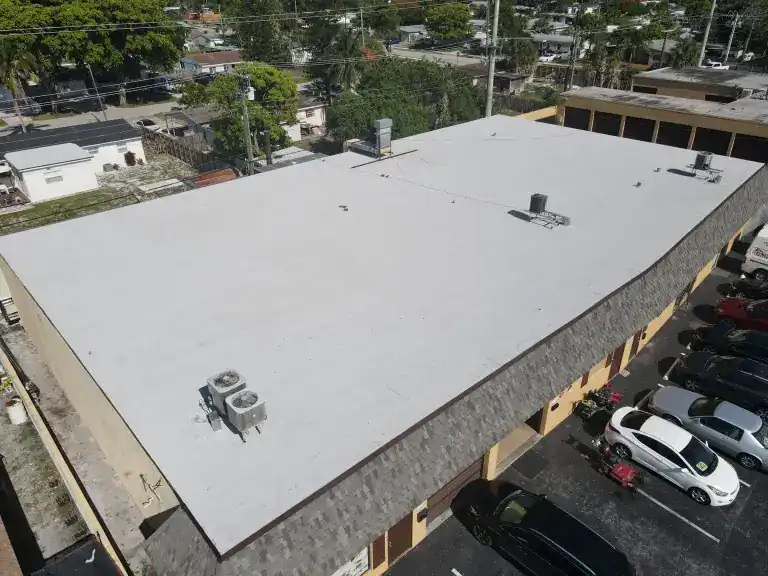
Most commercial roofs carry air handlers, exhaust fans and conduit. Each unit needs a curb or support flashed into the new roof, and each service visit is foot traffic on the membrane. We plan walkway pads along the paths technicians actually use, room around equipment to flash it properly, and condensate lines that run to a drain rather than onto the membrane.
Drainage is where flat roofs succeed or fail. Water has to reach a drain or scupper and leave: slope built into the deck or added with tapered insulation, drains sized for the roof area, overflow drains or scuppers as a backup, and crickets behind equipment and along walls. If the building already ponds, the new roof is the time to fix the slope, not cover the problem with fresh membrane.
Factor 5: How much heat does the roof take in?
The roof takes sun every day of the year here. A white membrane such as TPO reflects much of that heat instead of absorbing it, which keeps the space below cooler and eases the load on the air conditioning. Insulation under the membrane matters as much as the surface color: it slows heat moving into the building and keeps the underside of the deck above the point where condensation forms. A cover board over the insulation adds a harder surface under foot traffic.
Factor 6: How will the work affect the business?
Re-roofing an occupied building means noise, crews overhead and staging on the property. The plan we put in writing covers:
- Working the roof in sections, with each section dried in at the end of every day
- Keeping entrances, parking and deliveries workable, and where the dumpster and materials sit
- Protecting the interior and equipment below the work area, and coordinating with the mechanical contractor when units are lifted
- Scheduling around weather and the business's busy periods
How long it takes depends on size, weather and inspection scheduling. Permit timing varies by desk: Royal Palm Beach publishes a commercial review window of 15 to 30 business days, Palm Beach Gardens posts its own Reroofing Form 400 for flat roofs, and Boca Raton files through Boca eHub with plans on Boca Eplans. We build the schedule from the published process, not a guess.
What the inspection can and cannot tell you
A free inspection covers the membrane, seams, flashing at walls and curbs, drains, edge metal, coping and equipment supports, plus the underside of the deck where it can be seen from inside. What it cannot see from the surface is whether the insulation underneath is wet. When staining inside or soft areas on the roof point to trapped water, we explain what core cuts would confirm and list them separately in the scope.
Findings in photos, then a written scope
We photograph what we find, from the ponding pattern to the curb that is leaking, so ownership, management and the tenant all see the same evidence. You then receive a written scope with the price before any work starts. It names the system and product approval, the insulation and cover board, the attachment method, the edge metal, how drainage and equipment will be handled, and how concealed deck damage is priced if tear-off uncovers it. That lets you compare proposals on specifications, not just totals.
A commercial roof you can document
For a property manager, the roof's paperwork matters as much as the roof. Molsbee is Carlisle-certified for TPO, a GAF Certified Contractor and an Owens Corning Preferred Contractor, so the membrane, shingle and underlayment products we install carry the manufacturers' product warranties. The installation is covered by our lifetime workmanship warranty. Our Florida certified roofing contractor license is CCC1327429, we have worked in Palm Beach County since 1975, and when your insurer asks after the work, we provide a roof certification letter for your insurer. See our commercial roofing and TPO roofing pages for more.
Next step
Call (561) 318-8624 or request a free roof inspection to start with the building you have.